

When you look at a pool, it should not be a source of future maintenance anxiety. However, that peace of mind depends entirely on the materials beneath the surface. The pool surface types you choose directly impact durability, swimmer comfort, maintenance costs, and how well the pool holds up over time.
Choosing a pool finish is more than a design decision. While plaster and pebble have long been standard options, modern systems like INTER-GLASS® are increasingly evaluated for their long-term performance, reduced maintenance requirements, and ability to maintain a consistent appearance year after year.
INTER-GLASS® is a proprietary surfacing system available exclusively through our company. Unlike traditional finishes, it is engineered for superior crack and structural repair, making it an ideal solution for pools that require more than just a cosmetic facelift. Backed by a 25-year limited warranty, INTER-GLASS® offers long-term peace of mind, ensuring your pool stays beautiful, watertight, and worry-free for decades.
This article compares plaster, pebble, and INTER-GLASS® finishes in a real-world context. You will learn how each surface performs over time, what maintenance demands to expect, and why INTER-GLASS® is becoming a preferred pool surfacing solution for residential and commercial pools.
Why Pool Surface Choice Matters Long-Term
A pool interior operates in a demanding environment, remaining submerged year-round while exposed to sanitizing chemicals and daily wear. These conditions continuously stress the material composition. The surface you select directly influences:
- Algae and Stain Resistance: How easily contaminants attach to the walls.
- Structural Stability: How the finish handles seasonal temperature changes.
- Swimmer Comfort: How the material feels on skin and feet during use.
- Maintenance Costs: How often deep cleaning, acid washing, or resurfacing is required.
Plaster vs. Pebble vs. INTER-GLASS®
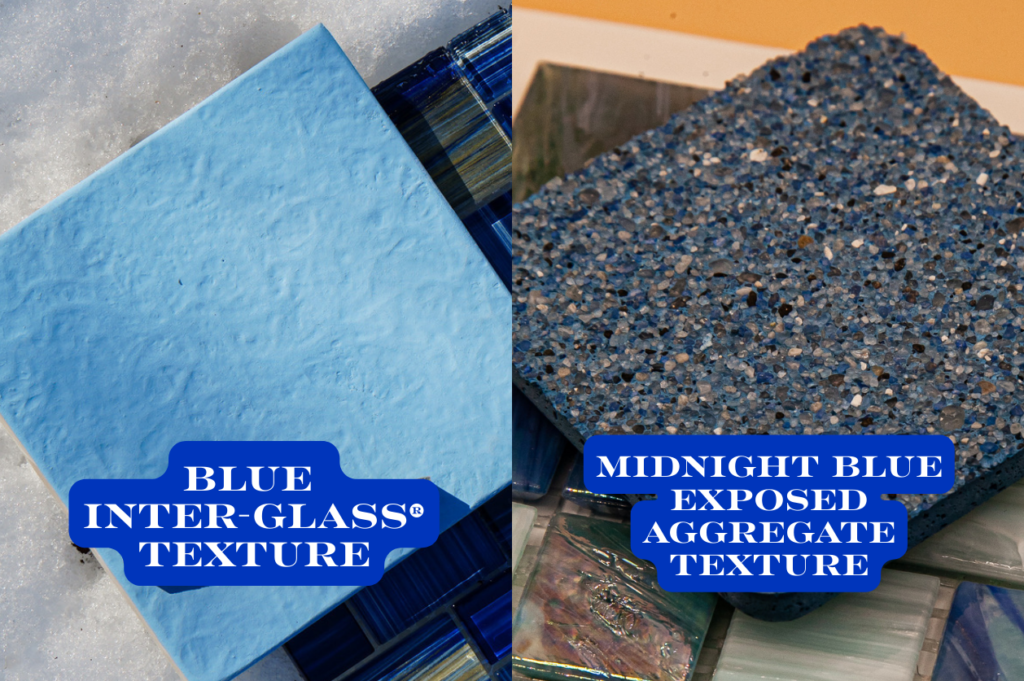
The practical differences between pool surfaces become most apparent after years of use rather than at installation. The comparison below reflects typical long‑term performance when surfaces are properly installed and routinely maintained.
| Feature | Plaster | Pebble | INTER-GLASS® |
| Surface feel | Smooth initially, becomes abrasive | Textured and uneven | Smooth, refined finish |
| Porosity | High | Moderate | Non‑porous |
| Stain resistance | Declines over time | Moderate | Strong |
| Algae attachment risk | Higher | Moderate | Lower |
| Visual consistency | Can mottled or fade | Naturally varied | Clean and uniform |
| Comfort for families | Declines with wear | Mixed | Consistently comfortable |
| Maintenance effort | High overtime | Moderate to high | Generally lower |
Pool Surface Types Explained
While many pool finishes appear similar when newly installed, their behavior diverges significantly as they age. Understanding the fundamental makeup of each option helps explain why these differences occur.
- Traditional Plaster Pool Surfaces
Plaster is a cement‑based finish made from white Portland cement and crushed marble. It has been used for decades because it offers a smooth appearance at installation and remains one of the most cost‑effective ways to finish a concrete pool.
The limitation of plaster lies in its porosity and chemical reactivity. Cement continuously interacts with pool water, which makes the surface sensitive to water chemistry fluctuations. Over time, this interaction can lead to staining, etching, surface roughness, and visual inconsistency, particularly if chemical balance is not perfectly maintained.
As a result, plaster is often considered a sacrificial surface. It is designed to wear gradually and eventually require replacement.
- Pebble Pool Finishes
Pebble finishes combine small stones or glass beads with a cement binder to create a textured, natural appearance. They are commonly selected as an upgrade from plaster due to their perceived durability and aesthetic depth.
While the exposed aggregate itself is resilient, the surface still relies on cement to hold everything together. As the binder ages and breaks down, pebbles can become more exposed, which increases surface roughness and can complicate cleaning. The added texture also creates more surface area where debris and algae can collect.
Pebble finishes typically outlast plaster, but they often do so with tradeoffs in comfort and maintenance effort. It is also important to recognize that the performance of a pebble surface is heavily dependent on geography. These finishes are significantly more common in southern climates because they often struggle to withstand the rigors of freeze-thaw cycles. In the Midwest, where temperature fluctuations are far more extreme, pebble finishes rarely last as long as they do in the South, which is why they are much less prevalent in our region.
The INTER-GLASS® Pool Surfacing System
INTER-GLASS® is a multi-layered composite pool interior system. Unlike other surface types, it does not rely on cement as its primary performance component.
Instead, INTER-GLASS® forms a reinforced, non‑porous composite lining that is bonded directly to the pool structure. High‑strength resins and reinforcement materials create a surface that is chemically inert, flexible, and resistant to the degradation commonly seen in cement‑based finishes. This is specifically engineered to address the failure points that limit the lifespan of traditional pool surfaces.
Surface Comfort and Swimmer Experience
INTER-GLASS® is designed to balance comfort and performance. Its smooth, composite-based finish is gentle on skin while still providing slip resistance where needed. This combination makes it suitable for everyday residential use as well as high‑traffic commercial and municipal pools.
Swimmer comfort becomes increasingly important in pools that see frequent use, serve families, or operate as commercial facilities.
Plaster can feel smooth when new, but etching and wear commonly lead to rough areas that cause scrapes and discomfort during extended swimming. Pebble surfaces provide traction, yet their inherent texture can be harsh on bare feet, knees, and hands, especially for children and seniors.
Maintenance and Ease of Cleaning
Maintenance demands often determine long‑term satisfaction with a pool surface.
Because plaster is porous, it allows oils, metals, leaves, and algae to embed more easily. This typically requires frequent brushing, strict chemical control, and persistent attention to waterline buildup. Pebble finishes are more durable, but their textured surface increases cleaning effort, particularly in corners and shallow areas where debris can settle.
INTER-GLASS® simplifies ongoing care by remaining non‑porous and chemically inert. Algae and contaminants have little to cling to, which makes brushing faster and staining less common. Many pool owners report more stable water chemistry, fewer stubborn stains, and shorter routine maintenance sessions.
Aesthetics and Long‑Term Appearance
A pool finish should enhance the look of the water rather than detract from it over time.
Plaster often begins with a bright, uniform appearance but may develop mottling, fading, or patchiness as it ages. Pebble finishes offer natural visual variation, which some owners appreciate, though consistency is not their defining feature.
INTER-GLASS® provides clean color clarity and enhanced light reflection, resulting in a crisp, vibrant appearance that remains consistent as the pool ages.
Proven Performance Across Pool Surface Types
With thousands of installations completed nationwide, INTER-GLASS® has demonstrated reliable performance in demanding environments. It is commonly used for residential pools, resorts, aquatic centers, universities, and municipal facilities.
The system installs directly over plaster, paint, or concrete and can also be applied to panel walls and one-piece fiberglass pools using specialized bonding methods. INTER-GLASS® is backed by a 25‑year limited manufacturer’s warranty covering shrinkage, cracking, flaking, and leaking through the surface when properly installed and maintained.
Choose INTER-GLASS® from Mid-America Pool Renovation
Plaster, pebble, and INTER-GLASS® can all produce visually appealing pools. The meaningful differences emerge over time as surfaces respond to chemistry, weather, and daily use. Plaster gradually wears and becomes reactive, while pebble offers durability with added texture and maintenance demands.
INTER-GLASS® stands apart by combining durability, comfort, stain resistance, and long‑term visual consistency through a system engineered to avoid the limitations of cement‑based finishes. For pool owners seeking a surface designed for longevity rather than replacement cycles, INTER-GLASS® represents a fundamentally different approach.
At Mid-America Pool Renovation, we pride ourselves on being renovation specialists who believe in doing the job once and doing it right. We offer decades of hands-on experience with complex residential, commercial, and municipal projects. Our team specializes in advanced surface preparation, including high-pressure hydro-blasting, and has installed INTER-GLASS® systems in some of the most demanding pool environments nationwide.
If you are ready to move away from the frustrations of traditional finishes and into a surface that actually performs, it’s time to talk about INTER-GLASS®.
