

When planning a swimming pool renovation, most pool owners start with a simple question: How much is this going to cost? It is natural to look for a single price tag or average number. However, anyone who starts researching pool renovation costs quickly discovers that baseline figures rarely tell the whole story.
There is no universal cost for renovating a pool because no two pools are identical. Every project features distinct dimensions, materials, existing conditions, location demands, and renovation goals for residential or commercial properties. A cosmetic resurfacing project involves a completely different scope of work than a full renovation that includes structural repairs, tile, coping, decking, plumbing, or accessibility upgrades.
Understanding the factors behind the price is far more useful than focusing on a single average cost. When you know what drives project scope, you can make smart decisions about where to invest your budget.
If you want a clearer picture of your own project, explore our Pool Budget Planning Guide and Custom Calculator to get a personalized ballpark estimate based on your pool. When you are ready to take the next step, start planning your pool budget with an expert evaluation.
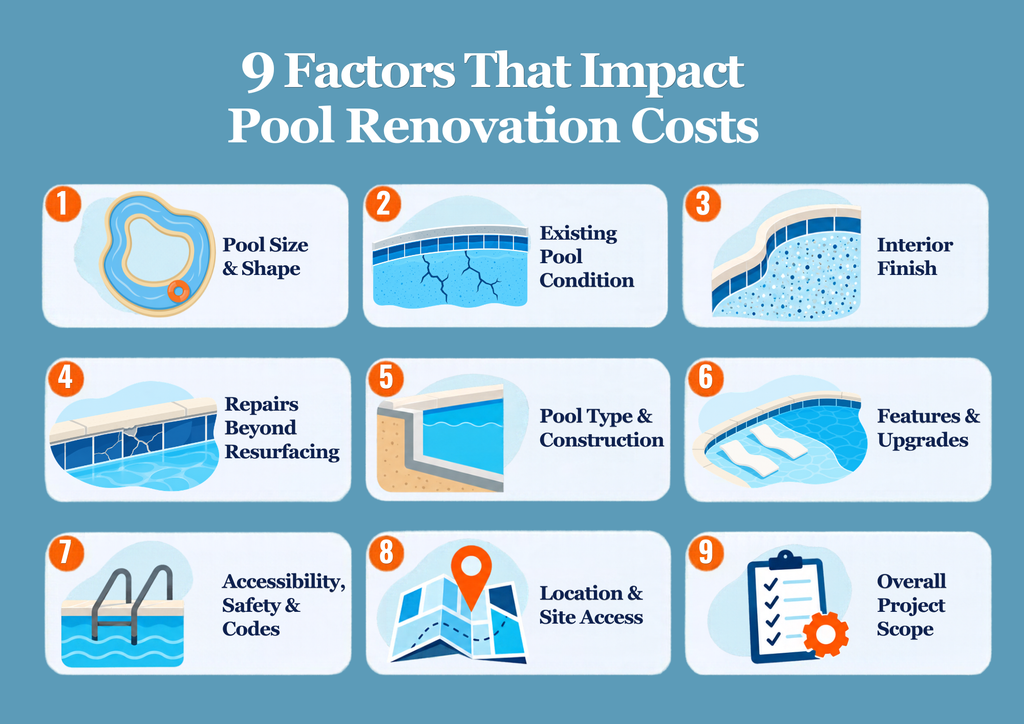
1. Pool Size and Shape
The physical size of your pool is one of the first factors that determines your overall renovation budget. Size directly dictates how much material your project requires and how many labor hours crews must spend on site.
More Surface Area Means More Materials and Labor
Larger pools require more resurfacing material, surface preparation, tile, coping, and labor. However, calculating material needs requires looking beyond simple length and width.
Interior surface area includes the floor, walls, transition slopes, and perimeter. A deep pool with a steep slope contains far more interior surface area than a shallow pool with the exact same length and width, which increases both material volume and labor time.
Complex Shapes Can Add Labor
Curves, unusual shapes, deep transitions, benches, and steps introduce extra complexity. A simple rectangular pool has a straightforward labor profile. Customized pools with detailed shapes require a specialized skill set.
Work on steps and benches requires real precision. Applying finishes to these areas is not a task for just anyone. Finishing steps and benches takes someone who is highly skilled at laying out curves and hand-troweling materials smoothly, much like delicate pottery or detailed cake decorating.
You are paying for both the raw materials and the high-level craftsmanship required to make those complex features look clean and last long. Pool dimensions establish your baseline investment, but size and shape are only the beginning of the story.
2. The Condition of the Existing Pool
The condition of the existing pool structure is one of the most important factors in pricing. It explains why two pools with the exact same dimensions can have dramatically different renovation costs.

A lasting resurfacing or renovation job depends entirely on proper surface preparation. Cracks, deteriorated plaster, loose material, damaged tile, and failing coping can quickly expand the scope of work. A contractor must fix these underlying issues before installing new materials.
The type of existing surface also determines how much work is required:
- Painted surfaces: If your pool was previously painted, that paint must be completely removed. New pool finishes will not stick or adhere to paint, making complete removal mandatory.
- Loose or deteriorating layers: If older layers of plaster are loose or peeling, workers must strip them off entirely down to sound concrete. Leaving bad layers underneath causes the new surface to delaminate and fail over time.
Renovation pricing should always account for what the pool actually needs to stay structurally sound, not just what it takes to make the surface look nice temporarily.
Surface Preparation Can Affect the Final Price
Proper preparation is an essential part of a lasting pool investment. Cutting corners on prep work leads to bond failure within just a few seasons.
Mid-America Pool Renovations uses high-pressure hydro-blasting as part of its surface preparation process. Hydro-blasting strips away old coatings and paint, removes weak concrete, and creates a clean, rough profile that gives new materials a permanent mechanical bond. While thorough prep work adds to the initial project cost, it protects your long-term investment.
3. The Pool Finish You Choose
The new interior finish you select has a major effect on total renovation costs. Pool finishes vary in upfront price, appearance, and lifespan:
- Traditional plaster: A classic white, cement-based finish that is generally the most economical option.
- Aggregate finishes: Cement-based finishes incorporating quartz or natural pebbles, offering a variety of colors and textures at a higher initial cost than traditional plaster.
- INTER-GLASS®: A premium, non-porous composite resurfacing system that requires a higher initial investment but offers long-term value through exceptional durability, reduced maintenance, and a 25-year limited warranty.
- Tile applications: Full tile or specialized tile applications offer a customized appearance and lasting durability, typically with higher material and installation costs.
Look Beyond the Initial Price
A lower-cost finish is not automatically the best value. Traditional plaster may cost less on day one, but its shorter lifespan means you will face resurfacing expenses again much sooner.
Consider durability, expected service life, maintenance needs, appearance, and environmental conditions. Finding the finish that fits your pool’s physical demands and long-term budget goals gives you the best return on your investment.
4. Repairs Beyond Resurfacing
Pool renovation means much more than just putting on a new surface. A comprehensive renovation addresses structural and mechanical health along with cosmetics.
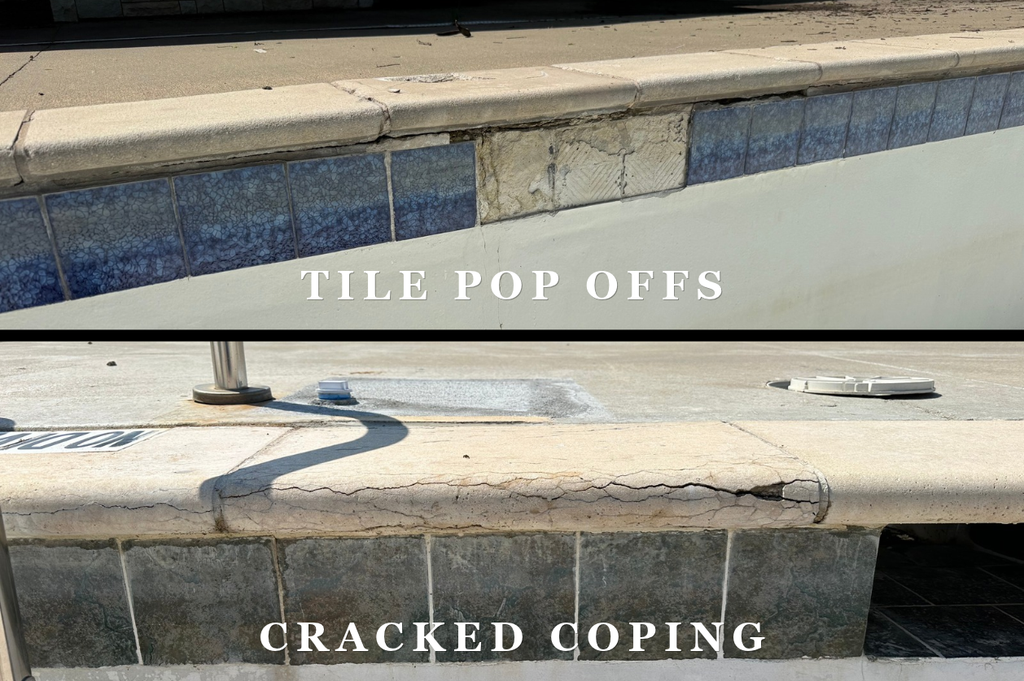
Additional repair work may include:
- Crack repair and structural stabilization
- Structural concrete repairs
- Tile replacement along the waterline
- Coping stone or poured coping replacement
- Deck resurfacing or replacement
- Plumbing improvements and pressure testing
- Circulation-system and filtration upgrades
- Accessibility improvements like ramps or lifts
- Pool reconfiguration to change water depths or layout
Small Visible Problems Can Point to Larger Work
Loose tiles or damaged coping are rarely isolated cosmetic issues. They often point to water getting behind the pool wall or movement in the deck due to freeze-thaw cycles.
Permanent repairs sometimes require replacing more than just the visibly damaged section to reach solid concrete and resolve the root cause. Scope dictates cost, and addressing these hidden issues early prevents total system failures later.
5. Pool Type and Existing Construction
Your pool’s core structure influences the renovation approach, technical tools, and labor involved. Common pool types include concrete, metal-wall, fiberglass, and vinyl liner pools. Moving from one surface or system to another substantially expands project scope.
Vinyl Liner Conversions
Converting a pool from a vinyl liner system to a hard surface is a great example of how changing a pool’s construction type expands a project beyond simple resurfacing.
At Mid-America Pool Renovations, we complete specialized vinyl liner conversions. This multi-step process involves:
- Removing the old vinyl liner and inspecting the underlying structure.
- Pouring a solid concrete bottom to replace the sand or vermiculite base.
- Installing our INTER-GLASS surface across the entire pool floor and walls.
Converting a vinyl pool eliminates the recurring cost of replacing torn or faded liners every few years and creates a permanent, solid pool structure. The more a renovation changes the existing pool framework, the more it moves beyond a standard resurfacing job, and the overall cost reflects that added work.
6. Additional Features and Custom Upgrades
Because renovating a pool involves draining the water and bringing equipment on site, many owners choose to add functional or design updates at the same time.
Popular upgrades include:
- Sun shelves or tanning ledges
- Zero-entry ramps
- New step configurations or built-in benches
- Water features like waterfalls or fountains
- Updated LED lighting systems
- New plumbing lines or dedicated vacuum ports
- Custom tile designs and depth markers
- Structural modifications to change pool depth
Decide Which Upgrades Are Worth Including Now
Combining related improvements while your pool is already drained can save money compared to doing them as separate future projects. However, every added feature increases scope, material volume, and labor hours. Prioritize upgrades based on your immediate usage goals and available budget.
7. Accessibility, Safety, and Code Requirements
For commercial pools, municipalities, schools, universities, hotels, and community facilities, safety and regulatory standards play a large role in building a budget.
Commercial renovation budgets may need to account for:
- Accessibility improvements, such as sloped entries or ADA lifts
- Safety modifications like VGB-compliant drain covers
- Facility-specific health department codes
- Required updates discovered during structural planning
Evaluating safety and accessibility requirements early ensures your facility stays compliant without unexpected mid-project delays.
8. Project Location and Site Accessibility
Where your pool is located and how easily crews and equipment can reach it will influence project costs.
Key logistical considerations include:
- Travel distance to the project site
- Access for heavy machinery, pumps, and delivery trucks
- Material delivery logistics
- Working space and staging areas around the pool perimeter
Based in Kansas City, Mid-America Pool Renovations completes projects nationwide. For projects requiring travel, we carefully plan crew mobilization, equipment transportation, material deliveries, and site logistics to help keep work running efficiently.
9. The Scope of the Renovation
The total scope of work brings all these factors together. It helps to understand the difference between a basic update and a full renovation:
- Basic renovation: Hydro-blast surface prep, applying a new interior finish, and addressing minor surface repairs.
- Comprehensive renovation: Surface prep, new interior finish, full tile and coping replacement, deck work, structural crack repair, plumbing upgrades, new features, and accessibility modifications.
The larger your project scope, the more important it becomes to establish clear priorities before requesting proposals.
Phasing Can Help Manage the Budget
Not every improvement has to happen at once. Some pool owners prioritize critical structural repairs and resurfacing first to protect the pool shell, then plan deck work or extra water features for a later season. Phasing your project over two or more years helps manage cash flow while keeping critical repairs on schedule.
How to Build a More Realistic Pool Renovation Budget
Building a practical budget starts with gathering a few basic facts about your pool:
- Pool size and shape
- Pool type and construction material
- Current surface condition
- Desired interior finish
- Repairs needed (cracks, tile, coping, decking)
- Additional features or accessibility upgrades
- Project location and site access conditions
- Desired project timeline
Want to see what your project could cost? Use our Pool Project Planning Tool to provide a few details about your pool and receive a personalized ballpark investment range.
Our calculator provides a realistic planning range to help you establish your budget. A formal proposal comes after our team evaluates the pool in person to verify specific site conditions and project scope.
Why the Lowest Pool Renovation Estimate Isn’t Always the Best Value
It is tempting to pick the contractor with the lowest price tag, but it is important to compare more than the bottom line on a proposal.
When evaluating estimates, compare:
- Quality of surface preparation (such as complete hydro-blasting versus using a bond coat)
- Material quality and finish durability
- Contractor experience with complex structural work
- Quality of workmanship and crew specialization
- Warranty coverage and company history
- Line-item clarity in the project scope
- Communication throughout the project planning stage
Choosing a contractor based on long-term durability, proper preparation, and proven craftsmanship gives you a far better return on your investment than picking the cheapest initial estimate.
Plan Your Pool Renovation Around Your Priorities
Pool renovation costs depend on size, surface condition, finish choice, structural repairs, added features, construction type, accessibility requirements, location, and overall scope. Because every pool has different structural needs, there is no single one-size-fits-all price tag.
Starting with a clear planning range helps you make informed choices about materials and project scope before signing a proposal. Mid-America Pool Renovations is an experienced partner who can help evaluate your pool’s needs and develop a tailored renovation plan.
Frequently Asked Questions
What is the biggest factor affecting pool renovation costs?
Overall project scope is the largest factor. Scope includes pool size, existing structural condition, the interior finish material you select, and whether you need extra repairs, tile, coping, decking, or plumbing work.
Does resurfacing a pool cost less than a complete renovation?
Generally, yes. Resurfacing focuses specifically on preparing the pool shell and applying a new surface finish. A complete renovation involves a broader scope that can include tile, coping, deck repairs, plumbing work, structural fixes, or adding new features.
Can I calculate my pool renovation cost before getting a quote?
Yes. The Pool Project Planning Tool gives you a personalized ballpark investment range based on your pool’s details. A formal quote is then provided after a project manager reviews your pool’s scope and physical condition.
